Custom System Integrations
We can accommodate any building management system, and we connect to it over whatever secure path the site allows. Sub Systems is where that flexibility shows: BMS graphics pages, a reclamation tank, a solar array, or any other system your team currently checks somewhere else.
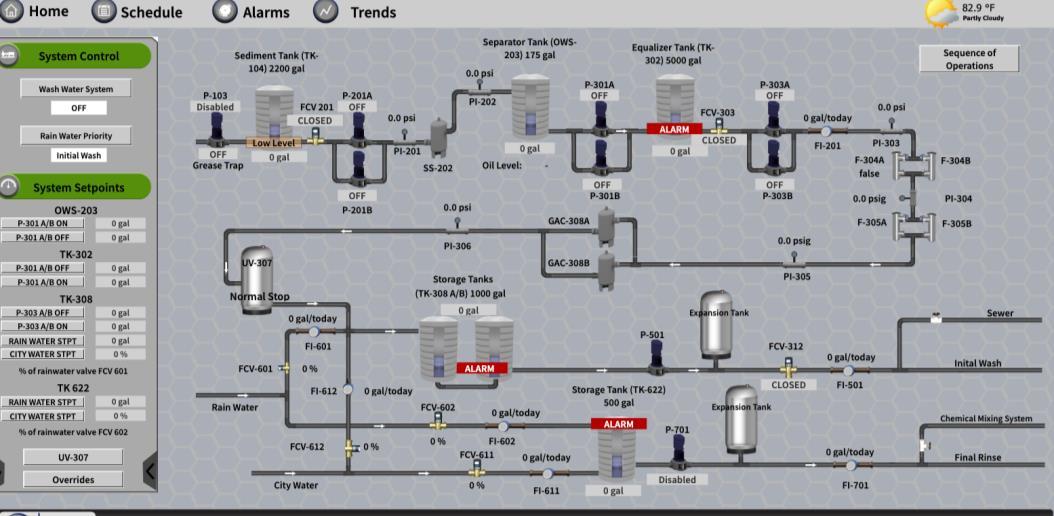
Any BMS, on a connection that fits the site
Whatever building management system you already run, we integrate with it — including the Niagara lines from Honeywell, Lynxspring, and Schneider Electric. We are not asking you to replace a working BMS, and we are not limited to one vendor: the platform is data-agnostic by design, and the building system you have is the one we connect to.
The connection is fitted to the site rather than dictated by us. Where opening the corporate network is not an option, a secure cellular VPN gives us a path that is independent of site IT entirely; where other secure routes are available, we use them. That flexibility is usually what decides whether an integration happens at all, because the blocker is almost never the software.
Custom by definition, not a fixed catalogue
Beyond the BMS, Sub Systems exists so that a system specific to your operation can be brought into Huckleberry and presented the way it needs to be presented — rather than left out because we did not anticipate it.
The module is scoped per client. If there is something your team currently checks somewhere else — a separate login, a local terminal, a vendor portal — it is a candidate for living here instead.
BMS graphics inside the platform
Building management graphics are the clearest example. The graphics pages your controls team built are usually the best view of a building that exists — and usually the least accessible, sitting behind a system most people in the organization will never log into.
Surfacing them in Huckleberry puts that view next to the energy and cost data it explains, for people who need to see the building without learning the BMS.
Reclamation, generation, and everything unmetered
Systems that generate, reclaim, or consume outside the utility relationship do not fit a billing-shaped data model, and forcing them into one usually means they go untracked. A rainwater reclamation system offsetting potable consumption is doing real work that never appears on any invoice.
Rainwater and greywater systems can be tracked on volume captured and reused, which is the number that justifies them. Solar can be tracked as generation against consumption, so the offset is visible rather than inferred from a smaller bill.
Why it belongs in the same platform
The argument for consolidation is not tidiness, it is reporting. Sustainability claims frequently depend on exactly these systems, and they are exactly the ones with the weakest data — a water reduction target met partly through reclamation needs the reclamation volume measured, not estimated, if the claim is going to hold up.
Keeping custom systems alongside billed utility data means the environmental and performance reporting can account for both without a manual reconciliation step, and without one more place your team has to remember to check.
Who it’s for
- Facility engineers and operators
- The systems you actually watch, in the same place as the consumption they drive.
- Controls contractors
- Put your BMS graphics in front of stakeholders who will never open the building system itself.
- Sustainability teams
- Measure the reclamation and generation your reduction claims depend on.
Related modules
- Live Equipment DataIntegrate any BMS — including the Honeywell, Lynxspring, and Schneider Electric Niagara lines — over a secure connection that fits the site.
- Facility ManagementLive meter readings, real-time demand monitoring, consumption heat maps by day and hour, and spike alerts ranked by what they actually cost you.
- Environmental FootprintCarbon and water tracked against your baseline year, normalized by the KPIs your organization reports on, and exportable as audit-ready ESG reports.
See it against your own sites
The fastest way to judge this is to point it at a handful of your buildings and see what comes back.
Request a demo